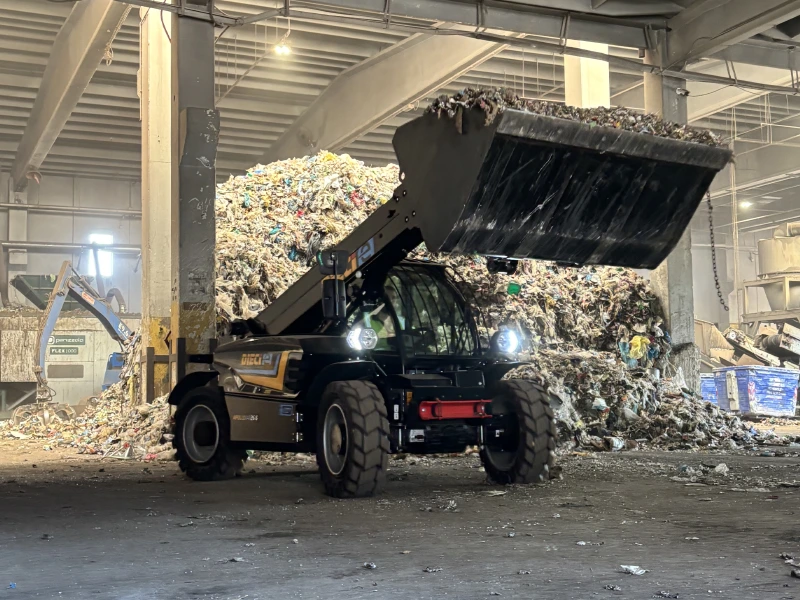
In the world of waste management and recycling, technological innovation plays a fundamental role in combining operational efficiency with environmental sustainability. For companies that choose to make sustainability a genuine strategy for success, initiating an ecological transition across their facilities, equipment and procedures is no longer merely an option, but a concrete necessity.
This is the virtuous case of Calabra Maceri e Servizi spa, based in Rende (CS), one of Italy’s most advanced companies in the green economy and a southern Italian leader in the field of integrated waste management.
Specialising in waste cycle management and offering a wide range of related services, Calabra Maceri has undertaken a major upgrade of its fleet in recent years, replacing traditional solutions with green work vehicles such as the Apollo-e 26.6 electric telehandler.
Telehandlers for the recycling of the future: environment and sustainability
Recycling is currently a rapidly expanding sector, increasingly focused on implementing ecological and environmentally friendly solutions. Within these operations, where the continuous handling of large quantities of material is required, often with multiple vehicles working simultaneously, adopting green and sustainable solutions is an important choice for safeguarding both operator well-being and the environment.
This is the policy pursued by the leading Italian recycling company Calabra Maceri e Servizi spa, which processes around 950 tonnes of domestic, industrial, commercial and craft waste every day. In recent years, the company has decided to extend its green approach to every aspect of its business:
- by focusing on renewable energy, through the installation of photovoltaic systems for self-generated electricity;
- by launching a fully electric vehicle fleet, a decision that led to the purchase of the Apollo-e 26.6 electric telehandler.
Why the Apollo-e
Recycling plants are often enclosed, dusty working environments with a high environmental impact. With this in mind, Calabra Maceri decided to take a bold step, transforming its facilities to minimise the company’s environmental footprint. A key element of this sustainability plan is the desire to progressively convert the vehicle fleet to electric power.
But the company’s mission is clear: to adopt sustainable, zero-emission solutions capable of delivering the same operating, durability, robustness and performance standards as traditional vehicles. With the aim of maintaining competitiveness and growth in the sector, Calabra Maceri has chosen to adopt DIECI’s Apollo-e 26.6 full-electric telehandler, which combines the proven performance of the traditional model, but with a green powertrain.
The Apollo-e 26.6 fully electric telehandler stands out for its:
- compact size;
- fully electric transmission;
- excellent performance;
- agility, even in confined spaces;
- 2,600 kg load capacity;
- 6-metre lifting height;
- 19 kW power output.
The adoption of an electric telehandler like the Apollo-e also helps reduce operating costs, thanks to lower maintenance requirements and increased energy savings compared to traditional internal combustion solutions.
But the Apollo-e 26.6 also stands out for other winning features as well, such as:
- Uncompromising safety, with warning systems, a rear-view camera and a 7″ display to keep movements constantly monitored;
- Exceptional comfort, with protection against heat and dust, allowing the operator to work in a spacious cab and focus entirely on the tasks at hand;
- Excellent manoeuvrability in all conditions, thanks to its exceptional steering angle and compact size;
- Versatility and ease of use, with a wide range of attachments (lifting hooks, various types of grippers, excavator and aggregate buckets, winches and baskets) and smart features, such as automatic attachment recognition.
The concrete advantages of electric power in waste disposal
In the recycling sector, the transition to electric power is not only an environmental choice, but is also a powerful driver of efficiency. In addition to delivering environmental benefits, choosing green and fully electric solutions also allows certain operating procedures to be simplified, all while meeting the statutory and regulatory requirements.
By adopting an electric telehandler, it is possible to obtain:
- a zero-emission solution, ideal for indoor facilities, warehouses and landfills;
- significant noise reduction for operators;
- lower operating and maintenance costs;
- compatibility with internal energy production systems, such as photovoltaic power generation;
- enhanced brand awareness and positioning, with a more sustainable corporate image, which plays an increasingly strategic role for public tenders and environmental calls for bids.
With the introduction of the Apollo-e 26.6, Calabra Maceri has strengthened its sustainable positioning, demonstrating that the adoption of fully electric solutions is feasible, even in intensive operating contexts like recycling.
It’s a project that attests to the company’s shared vision with DIECI: innovation aimed at making everyday work activities less harmful to the environment, without compromising on performance or productivity.
Calabra Maceri: when sustainability becomes a strategy for success
Born from a family tradition in waste recovery, Calabra Maceri is now one of the largest companies in the sector, having grown through sustainable investments, and now employing 500 people.
Each year, working in collaboration with Italian and international industrial partners, the company receives, recycles and directs tonnes of domestic, commercial, industrial and craft waste for recovery.
Calabra Maceri stands out for its integrated vision of the waste cycle, offering a wide range of services, such as:
- collection and transport, with approximately 35,000 pick-ups per month;
- treatment of urban and industrial materials;
- environmental sanitation services;
- asbestos removal;
- rat extermination.
Applied across the various branches of the company, its green approach has made it a recognised player in Italy and a pioneer of the ecological transition, which is increasingly taking hold at both the regional and national levels.
With the new DIECI electric telehandler, Calabra Maceri has the opportunity to further improve its competitiveness on the market, without compromising on sustainability. With the Apollo-e, functionality, sustainability and manoeuvrability come together seamlessly to drive the future of the recycling sector.