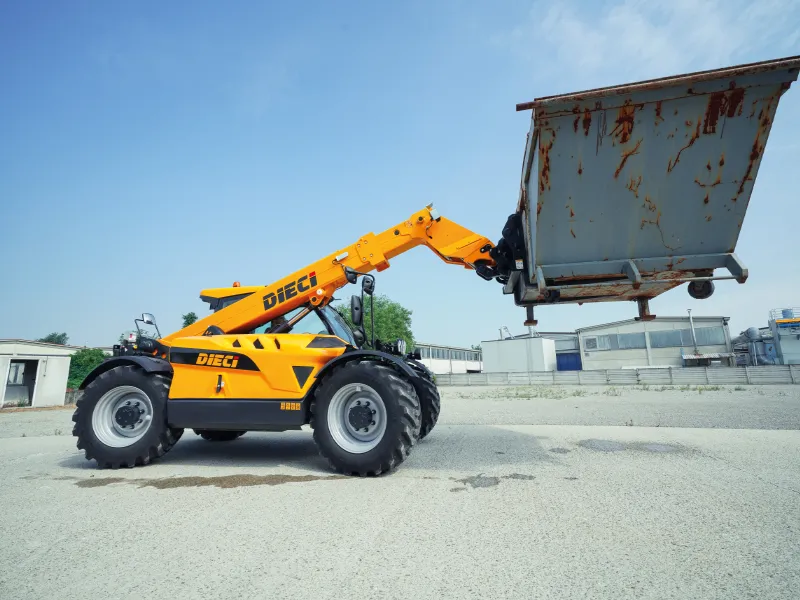
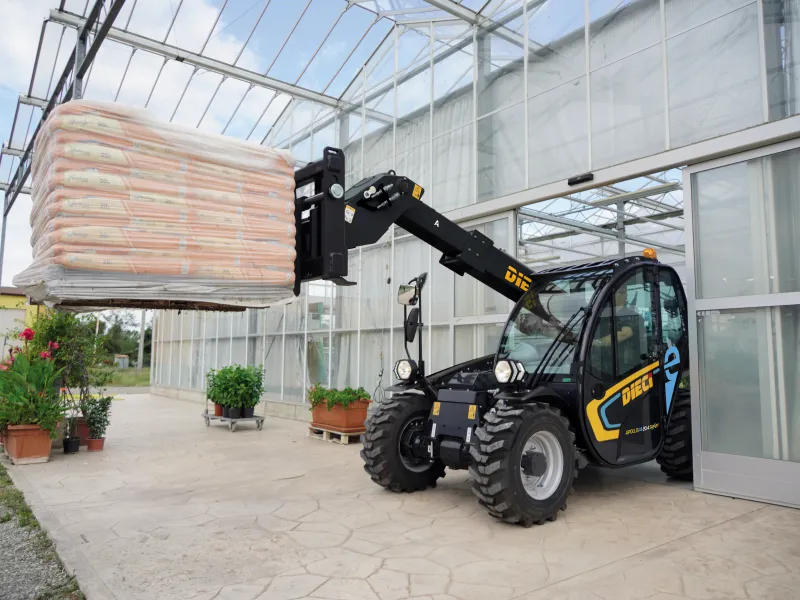
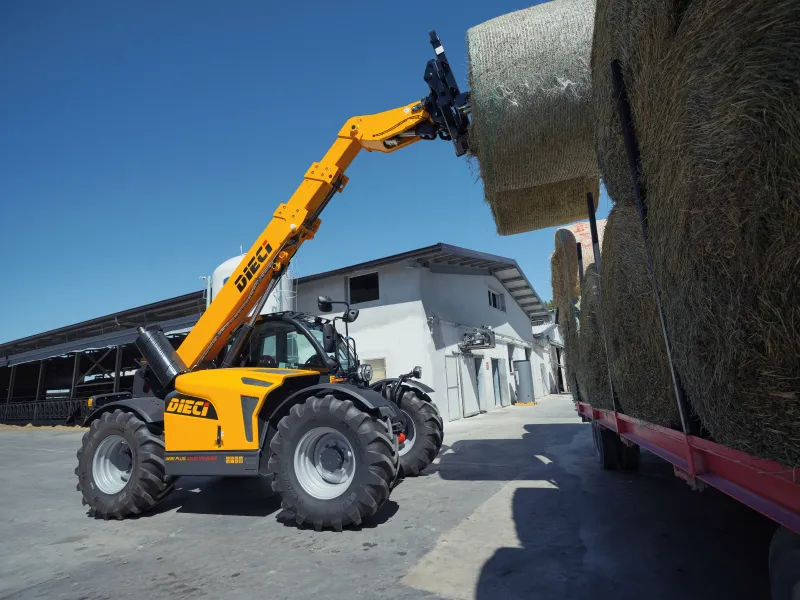
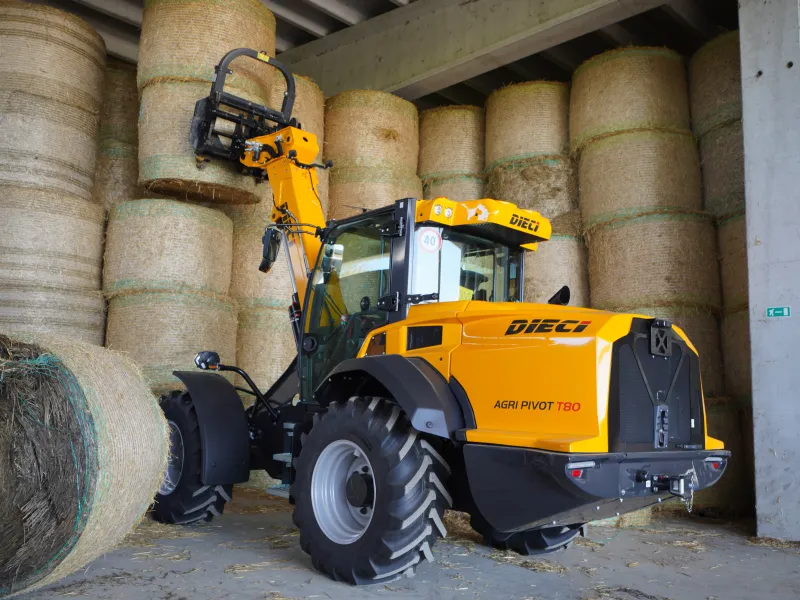
Choosing a telehandler does not simply mean comparing lifting height and lifting capacity. The most suitable machine depends on the type of work to be carried out, the industry, manoeuvring space, terrain conditions, required attachments and frequency of use.
Summary
To choose a telehandler, it is necessary to assess lifting height, actual lifting capacity, outreach, manoeuvring space, terrain type, power source, attachments and frequency of use.
The best model is not necessarily the most powerful one, but the one that best matches the application: construction, agriculture, industry, mining, emergency operations or low-emission environments.
What is a telehandler?
A telehandler is a machine designed to lift, transport and position materials by means of a telescopic boom on which different attachments can be mounted.
It is designed to operate on:
- uneven terrain;
- confined spaces;
- industrial, agricultural and construction site environments.
Unlike a traditional forklift truck, a telehandler combines:
- lifting height;
- forward outreach;
- operational versatility.
First question: what kind of work does the telehandler need to perform?
The first mistake is starting from the model itself. The choice of a telehandler should begin with the actual application: what it needs to lift, where it needs to operate, how frequently and with which attachments.
Key questions:
- Do I only need to lift the load, or also position it accurately at height?
- Do I always work in the same environment or in different operating conditions?
- Do I need specific attachments such as forks, bucket, platform, hook, winch or clamps?
Fixed, articulated or rotating telehandler: which one should you choose?
| Operating requirement | What to assess | Most suitable type |
|---|---|---|
| Handling pallets, construction materials, bags and standard loads | Capacity, outreach, visibility, turning radius | Fixed telehandler |
| Working at height on complex construction sites | Height, stabilisers, lifting attachments for people/materials | Rotating telehandler |
| Operating in agricultural businesses | Compactness, traction, comfort, agricultural attachments | Agricultural telehandler, fixed or articulated |
| Operating in confined spaces | Dimensions, steering axles, visibility, manoeuvrability | Compact or articulated telehandler |
| Mining, quarries, tunnels | Robustness, special attachments, stability on difficult ground | Heavy-duty telehandler |
| Emergency operations and civil protection | Customisation, speed, special attachments | Telehandler with dedicated configurations |
| Operating indoors or in environmentally restricted areas | Emissions, noise levels, Runtime, charging times | Electric telehandler |
Fixed telehandler
The fixed telehandler is the most straightforward choice when the main task is lifting, transporting and positioning loads in front of the machine. In construction, it can replace forklift trucks, aerial platforms and, in some applications, cranes, if equipped with the appropriate attachments.
It is recommended when the following are required:
- productivity in repetitive operations;
- ease of use and versatility;
- good manoeuvrability;
- adaptability to rough terrain;
- agility in material handling on construction sites or within businesses.
Articulated telehandler
The articulated telehandler is ideal when the main challenge is reaching confined areas and working with greater visibility and manoeuvrability. This type of machine features a centrally positioned boom designed to provide full control over the load.
It is suitable for:
- agricultural businesses with limited space;
- warehouses, barns and courtyards;
- nurseries, livestock farms and storage areas;
- operations where operator visibility is crucial.
Rotating telehandler
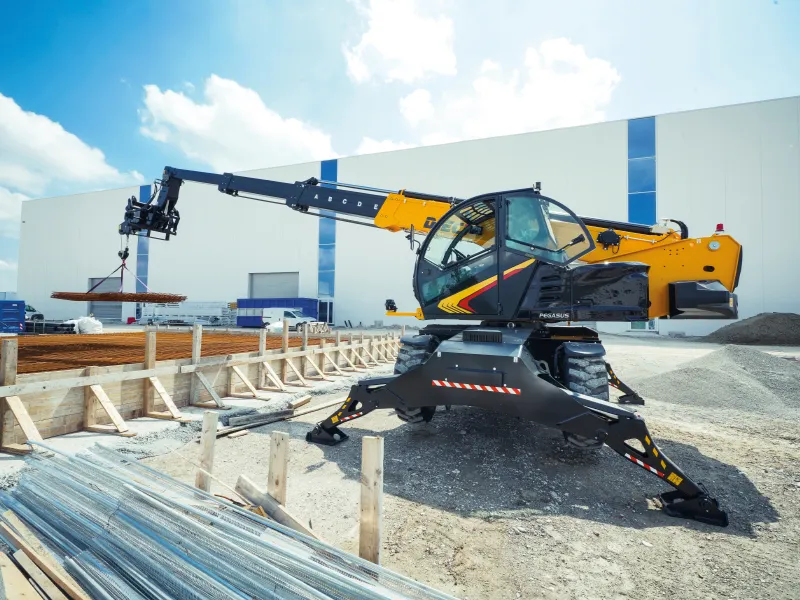
The rotating telehandler is the solution to consider when a construction site requires wide operational coverage, lifting at height and multiple functions with a single machine. Rotating telehandlers may feature continuous 360° rotation or non-continuous 400° rotation.
In construction, a rotating telehandler can operate as:
- fixed telehandler;
- aerial work platform;
- crane with hook or winch.
Electric vs diesel telehandlers: which one should you choose?
The choice of power source is becoming increasingly important when selecting a telehandler, as it directly affects performance, operating costs and the operating environment.
Diesel telehandler
Diesel models are currently the most common solution for intensive outdoor operations: they ensure high autonomy, quick refuelling and operational continuity even in demanding conditions. They are recommended when the machine must operate continuously for many consecutive hours.
Electric telehandler
Electric telehandlers, on the other hand, are becoming increasingly relevant in environments where low emissions and reduced noise impact are required. They are particularly suitable for indoor operations, urban areas or environments subject to environmental restrictions. They offer the advantage of producing no direct emissions and operating more quietly, but require careful management of battery life and charging times.
Electric vs diesel telehandlers
| Feature | Electric telehandler | Diesel telehandler |
|---|---|---|
| Emissions | No direct emissions | Exhaust gas emissions |
| Noise levels | Very low | Higher |
| Ideal environment | Indoor spaces, urban areas, sensitive environments | Outdoor construction sites, demanding environments |
| Autonomy | Limited by battery capacity | High, dependent on fuel |
| Operating time | Dependent on charging cycles | Continuous with rapid refuelling |
| Maintenance | Reduced | More frequent |
| Operating costs | Lower in the long term | Variable (fuel + maintenance) |
| Environmental impact | Reduced | Higher |
| Initial investment | Often higher | Variable, often more accessible |
| TCO | Lower in the medium-to-long term | Competitive in the short term |
7+1 practical criteria for choosing a telehandler
1. Lifting height
It is not enough to ask “how high can it reach?”. It is necessary to understand the actual working height required. Lifting height indicates how high the boom can reach.
How to choose:
- < 10 m → standard handling (warehouses, agricultural businesses);
- 10–20 m → construction sites, general construction;
- > 20 m → structural works, major projects, special applications.
Common mistake: overestimating lifting height and choosing a machine that is more expensive and less agile than necessary.
2. Capacity
The lifting capacity of a telehandler indicates the maximum weight the machine can lift under specific operating conditions. It is one of the main parameters to assess, but it is not a fixed value. A telehandler does not lift the same weight in all configurations; capacity depends on:
- boom height;
- forward outreach;
- machine configuration;
- possible use of stabilisers;
- mounted attachment.
Practical rule: always check the load chart, not just the maximum lifting capacity.
3. Horizontal outreach
Horizontal outreach determines how far the load can be positioned without moving the machine. It is one of the most important parameters when obstacles are present or when it is not possible to get close to the working point.
It is essential when:
- there are obstacles (walls, scaffolding, excavations);
- it is not possible to approach the working point;
- work is carried out on multiple levels.
4. Manoeuvring space
In historic city centres, agricultural businesses with narrow courtyards or urban construction sites, compactness may be more important than maximum power.
Key factors include:
- turning radius;
- machine dimensions;
- lateral stability;
- ease of driving.
Suggestion: in these cases, a more compact machine is often preferable to a more powerful one.
5. Terrain
A telehandler must also be chosen according to terrain conditions. The same machine may behave differently on stable yards, agricultural ground, mud, gravel, quarries, uneven areas or slopes. One of the advantages of telehandlers is their high manoeuvrability even on rough or uneven terrain.
Terrain types:
- stable → no specific requirements;
- agricultural → traction and stability are required;
- muddy → attention must be paid to weight and tyres;
- quarry/mining → robustness and protections are essential.
6. Power source
The power source must be assessed according to the operating environment and continuity of use. Diesel is recommended for intensive outdoor work, while electric is suitable for indoor environments, sensitive areas or contexts with restrictions on emissions and noise levels. Key factors include the availability of electrical infrastructure and the possible presence of self-production or energy recovery systems such as photovoltaic panels.
In summary:
- diesel: autonomy, power and continuous outdoor operation;
- electric: sustainability, quiet operation and low-emission environments.
7. Attachments
Attachments radically change the way the machine can be used. A telehandler can be configured with forks, buckets, work platforms, lifting hooks, winches, trusses, bale clamps and other equipment.
Guiding principle:
- more compatible attachments mean greater versatility;
- the value of the machine also depends on how many functions it can perform.
Suggestion: the more genuinely useful attachments available, the greater the return on investment.
| Main attachments | When they are needed |
|---|---|
| Forks | Pallets, construction materials, agricultural loads |
| Bucket | Aggregates, grain, loose materials |
| Work platform | Working at height, maintenance, construction |
| Hook / winch | Material lifting, assembly operations, partial crane replacement |
| Bale clamps | Haymaking and livestock farming |
| Special clamps | Mining, vehicle maintenance, pipes, tyres, timber |
7+1. Purchase or rental?
The final factor to assess is whether to purchase or rent the telehandler. The choice between purchase and rental depends on frequency of use, project duration, budget, maintenance and variability of applications.
When to purchase:
- daily use;
- repetitive operations;
- need for dedicated attachments.
When to rent:
- occasional operations;
- temporary requirements;
- specific construction sites.
Mistakes to avoid when choosing a telehandler
An effective purchasing guide should also consider the most common mistakes. Avoiding them reduces the risk of choosing a machine that is oversized, undersized or unsuitable for the actual work.
- choosing solely on the basis of maximum lifting capacity without checking the load chart;
- ignoring outreach and focusing only on lifting height;
- purchasing a machine that is too large for the available spaces;
- failing to assess required attachments beforehand;
- choosing diesel or electric without considering autonomy, charging, emissions and TCO (Total Cost of Ownership);
- overlooking assistance, spare parts availability and dealer network.
How to choose a telehandler according to the industry
Construction
In the construction sector, telehandlers are used to handle aggregates, transport and lift loads and people. They can replace forklift trucks and aerial work platforms depending on the mounted attachments.
What really matters:
- height + outreach;
- rotation (continuous or non-continuous);
- versatility (attachments);
- ability to operate in complex spaces.
Purchasing criterion: in construction, the starting point must be the geometry of the site itself: height, manoeuvring spaces, access points, ground conditions and the need for a basket to lift people and materials at height. Ease and intuitiveness of use are equally important, together with safety systems that allow operators to become productive immediately.
Learn more about how to use it on public construction sites.
Agriculture
In agriculture, telehandlers support the transport, lifting and positioning of loads. Dieci’s agricultural range is designed for small, medium and large businesses, with a wide range of attachments and configurations to provide the machine best suited to operational requirements.
Applications:
- grain storage and distribution;
- livestock farming;
- horticulture and nurseries;
- biogas;
- maintenance of barns, silos and business facilities.
Purchasing criterion: in agriculture, versatility, comfort, visibility, attachments, stability and the ability to operate in repetitive cycles are key.
Discover how a traditional agricultural business in Emilia-Romagna uses Dieci telehandlers.
Mining, quarries and tunnels
In mining, telehandlers operate in hostile environments. A telehandler can be useful for machinery maintenance, tunnel outfitting, conveyor belt assembly, installation of electrical systems and ventilation.
Dedicated attachments:
- cylinder clamps;
- tyre clamps;
- steel arch installation clamps;
- pipe clamps;
- dedicated work platforms, including roof-protected baskets for tunnels and galleries.
Purchasing criterion: priority should be given to robustness, safety, special attachments, service support and dedicated configurations.
See how a three-boom telehandler with steel arch installation clamp operates.
Emergency operations and civil protection
Telehandlers are widely used in the emergency sector. Their versatility, customisation possibilities and special configurations make them highly functional in contexts where speed, versatility and reliability are required. They can be used by the army, firefighters, forestry agencies and civil protection organisations.
Applications:
- debris removal after earthquakes or natural disasters;
- maintenance of power line poles;
- tree maintenance at height;
- support for firefighting operations;
- handling of weapons, fuel, food and materials.
Purchasing criterion: travel speed, versatility, customisation, safety systems and reliability.
Discover attachments, configurations and advantages.
Service, dealers and after-sales support: why they matter when choosing
A telehandler is a working machine and the choice should not stop at the declared performance specifications.
The professionalism of the dealer, the quality of the initial consultation and the direct relationship between dealer and manufacturer all affect long-term operational continuity.
A competent dealer helps translate operational requirements into a concrete configuration: model, power source, attachments, tyres, configurations, maintenance and training. The direct connection with the manufacturer is important because it allows technical updates, spare parts, specialist service and after-sales support to be managed more effectively.
When choosing a supplier, it is advisable to assess:
- dealer experience in the relevant application sector;
- ability to recommend the right model based on the application, not just the budget;
- availability of technical assistance and scheduled maintenance;
- rapid access to spare parts and attachments;
- direct and structured relationship between dealer and manufacturer;
- availability of after-sales support to reduce machine downtime.
Checklist before purchase
| Question | Why it matters |
|---|---|
| What is the actual maximum load to be handled? | Prevents undersizing |
| At what height do I need to work? | Determines the machine category |
| How far forward do I need to reach? | Used to assess outreach |
| Do I work in confined spaces? | May indicate compact/articulated models |
| Is the terrain stable or uneven? | Affects traction, stability and safety |
| Do I need to lift people? | Requires work platform compatibility |
| How many attachments will I actually use? | Determines machine value |
| Continuous or occasional use? | Helps choose between purchase and rental |
| Is service support available nearby? | Essential for downtime and maintenance |
Conclusion: what is the best telehandler?
The best telehandler is the one that balances height, actual lifting capacity, outreach, manoeuvrability, power source, attachments and service support according to the specific application.
There is no absolute “best” model, only the one best suited to the operating context. For this reason, the choice should start from the application itself, be verified against the technical data sheet and conclude with an assessment of the dealer and after-sales support.
FAQ – The most common questions about telehandlers
How are the “best” models selected?
Telehandlers considered among the highest performing share several characteristics:
- adaptability to multiple applications;
- compatibility with different attachments;
- operational stability and safety;
- ease of use;
- ability to operate in demanding conditions.
For this reason, comparisons between models are based more on actual performance and real-world use than on absolute rankings.
What are the best telehandlers?
There is no absolute “best telehandler”: the choice always depends on the application, the operating environment and the required performance. The European market includes several specialised manufacturers offering ranges designed for construction, agriculture, industry and special applications.
More than the brand itself, what matters is the consistency between the machine and the actual application: lifting height, capacity, outreach, manoeuvrability and available attachments.
Best telehandlers by type of application
| Application | Type | Key features | Example range |
|---|---|---|---|
| Urban construction sites and renovations | Compact / fixed | Compact dimensions, agility, versatility | Apollo |
| Construction and major projects | Rotating | High lifting height, rotation, multifunctionality | Pegasus |
| Agriculture | Agricultural fixed | Operational continuity, comfort, dedicated attachments, integration with tractor activities | Agri Farmer |
| Heavy industrial applications | Heavy duty | High capacity, robustness | Hercules |
| Indoor or sensitive environments | Electric | Zero emissions, low noise levels | Apollo-e |
Which telehandler models should be chosen for specific applications?
The choice of model always depends on the type of application. Some examples help identify the most suitable configurations available on the market.
- For complex construction sites and work at height, rotating models from the Pegasus Essential or Pegasus Classic ranges are used when operating height and versatility are required.
- For everyday agricultural activities, models such as Agri Farmer or Agri Plus are suitable for repetitive handling operations and continuous use within the business.
- In confined spaces or environments with limited access, compact solutions such as Mini Agri 26.6 or Mini Agri 20.4 Smart provide greater manoeuvrability.
- For more demanding applications and frequent travel, Agri Max Power X2 can speed up operations thanks to a maximum speed of 50 km/h.
- For industrial applications, high-capacity models such as Samson or Icarus Dynamic are used for heavy-duty and intensive operations.
These examples show that the choice of model does not depend on a general ranking, but on the match between technical features and the type of work to be performed.
When is it worth using a telehandler instead of a forklift?
A telehandler is preferable when:
- work at height is required;
- the terrain is uneven;
- distant points must be reached;
- multiple attachments are required.
A forklift is more suitable for flat surfaces, low heights and enclosed spaces.
How much does a telehandler cost?
The cost varies according to:
- type (fixed, rotating, compact);
- performance;
- attachments;
- configuration.
For this reason, it is difficult to indicate a single price range: prices vary from compact machines to high-performance models with significantly higher costs.
Where can you buy a telehandler?
A telehandler is generally purchased through authorised dealers.
Dealers provide consultation in choosing the most suitable model and after-sales services.
Purchasing through a dealer is important because it guarantees qualified technical support, access to certified machines and long-term operational continuity.
Is a licence required to operate a telehandler?
Yes. Professional use of a telehandler requires specific training and certification for the use of work equipment. Before operation, it is necessary to verify requirements, mandatory training, safety procedures and regulations applicable to the operating context.
Certification does not replace risk assessment: the operator must know the machine, the load chart, the mounted attachments and the conditions of the working environment.